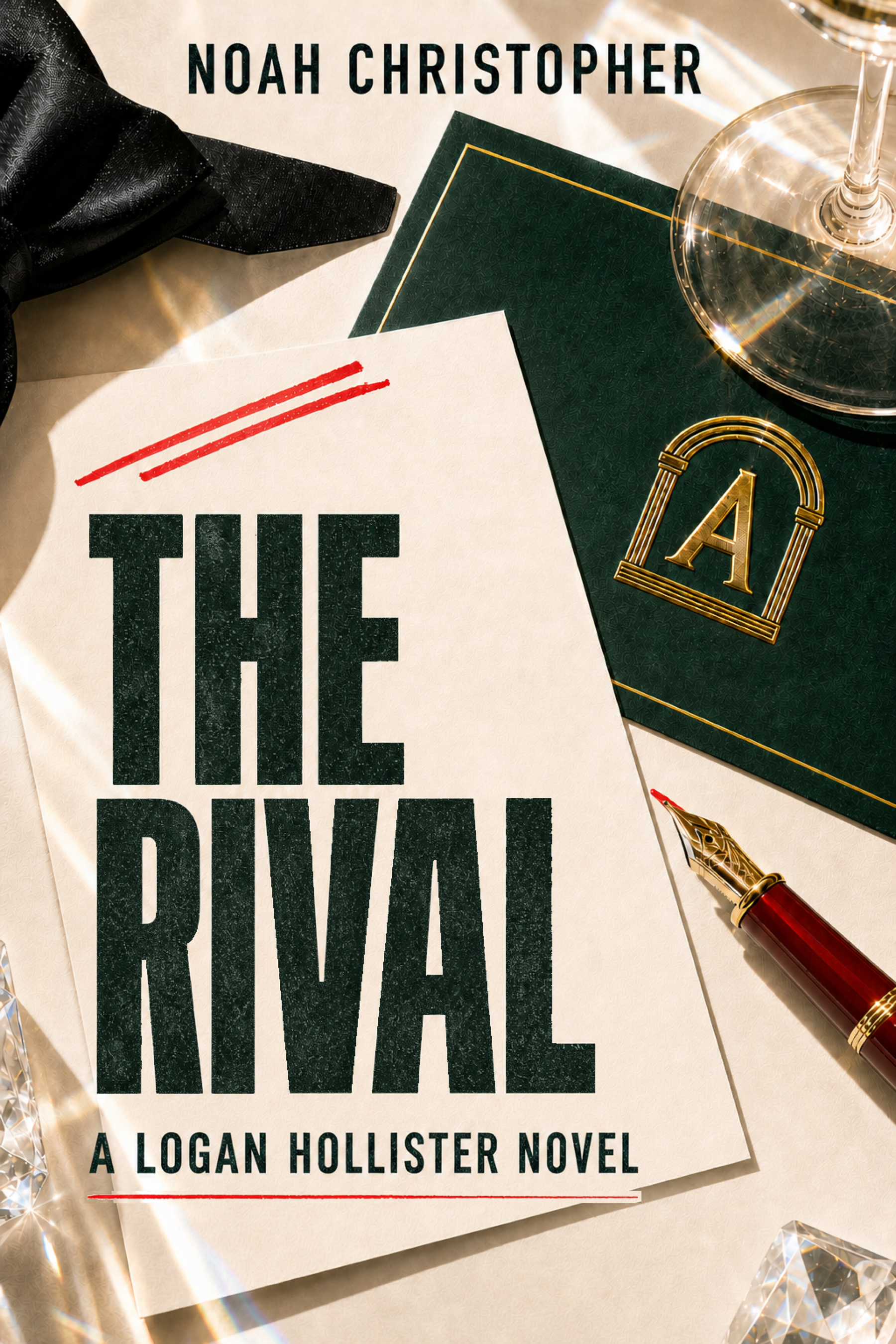
The Rival by Noah Christopher
PREVIEW OF BOOK 2
For Emily
ONE

THE TOAST

The trick to killing a man in front of four hundred witnesses is to make sure every one of them is watching. Tripp Ashworth stood twelve feet from the stage with a glass of champagne he had no intention of drinking, admiring his audience—the silk, the diamonds, a senator’s widow laughing at a lobbyist’s joke, four hundred of the city’s finest dressed for a night they’d be telling stories about for the rest of their lives. None of them knew they were in a show. That was his favorite part. Opening night only comes once.

The Aurora Ballroom had been built by his grandfather to make people feel the evening was about them, and it worked on everyone, every time. Six chandeliers of hand-set crystal, dimmed tonight to the exact amber that flattered aging skin and elective surgery alike. A string quartet sawed away under the noise. The gold Ashworth A stood over the stage, alone and unmistakable, needing no introduction here or anywhere else—money that never had to raise its voice.

He moved through them easily; he had been working rooms like this since he was tall enough to be introduced. A touch on an elbow here. A name remembered there—he remembered all of them; other men kept box scores, he kept people. He knew what the developer by the ice sculpture had paid for his wife’s earrings, and knew the wife had chosen them herself. He knew which of the two councilmen at the bar was going to be indicted in the spring, and knew the man didn’t know it yet. Knowing things was not a talent. It was what collected in a man with nothing else to do.

His grandfather built the hotels; his father protected them, mostly by refusing to rock a boat that size; and Tripp had arrived third, into a world already finished, with nothing required of him but that he not embarrass it. Everyone had assumed he would go by Trey. Trey was what you called the third one—the spare, the Roman numerals on the trust. He had gone by Tripp instead, because Trey was what an ordinary man would have chosen, and he had never had much use for anything an ordinary man would do.

“Tripp Ashworth.” A hand landed on the midnight blue of his shoulder—Bill Harmon, hotel foundation board, the gin already working. “Tell me your grandfather’s smiling down on all this.”

“He didn’t smile much even in this room, Bill,” Tripp said warmly, and Bill laughed as though it were the finest thing he’d heard all year, and Tripp was gone before the man could assemble a second sentence.

The guest of honor stood near the stage, exactly where a guest of honor should, holding court in a white dinner jacket he had plainly bought for the occasion and would plainly never wear again. Raymond Delgado. Thirty years running the Milagro Fund, which put broken children back together and asked their parents for nothing, and had done it so long and so well that even this room—which didn’t love easily—appeared to genuinely love him. He would be given an award tonight, and then he would retire, and the papers would use the word beloved, and for once it would be accurate.

Tripp liked him—actually liked him, no performance in it. It simply had nothing to do with anything.

“Mr. Delgado.” He took the old man’s hand in both of his—the warm one, the two-handed clasp that tells a man he is the only person in the room. Up close Ray had kind eyes, a fresh barber’s cut, and a flower going crooked on his lapel.

“Tripp Ashworth. Still ‘Mr. Delgado,’ after all these years.” Ray gripped back. “You’ve outdone yourself with this room tonight.”

“My family’s only the landlord. You’re the reason anyone came.”

“The famous Ashworth humility.”

“Infamous, mostly.” Tripp let his other hand come to rest on the old man’s shoulder, set the flower straight on his lapel—good wool, Raymond, you spent too much—patted it flat, and grinned. “I wanted the handshake before the crowd got greedy. Enjoy every minute up there. You’ve earned all of them and then some.”

Pilar had Ray’s arm, bright-eyed, half his size. Tripp turned the smile on her without letting go of Ray. “Mrs. Delgado. When they’re all on their feet for him tonight, half of it is yours.”

“More than half,” Pilar said.

Ray laughed, and gripped Tripp’s hand hard, the grip of a man who meant things. “Thank you, son.”

“Thank you.” Tripp released him and stepped back into the crowd, and it was done—the first piece, clean, a small precise click landing somewhere only he could hear.

Dinner was called, and four hundred people performed the little comedy of finding their names on their cards and pretending they didn’t care where they’d been seated. Tripp had been placed at a good table, not the best one. He had asked for it that way months earlier, a note to the banquet office in his own hand—nothing near the front, I’m hopeless at these things—because people remembered a man who declined the good seat, and it was the cheapest thing in the world to buy, and almost no one thought to buy it.

The champagne was a 2012 Krug, which Tripp Ashworth considered a generous send-off for a man who wouldn’t live to finish his glass. He touched it to the table when they toasted the foundation, and set it down full.

He ate a little. He was charming to the museum chair on his right, a woman with three ex-husbands she discussed like acquisitions. He watched the head table between courses, and waited for the moment the room would hand him.

It arrived with the dessert plates. The head table came apart into the happy disorder that always takes over late at these things—servers reaching between shoulders for the china, a hired photographer herding people into a group picture, a receiving line forming of donors and board members and a small determined nun, everyone wanting their thirty seconds with Ray before the program took him. Tripp rose and joined the line, because not joining it would have been the strange thing to do. Half the room wanted to lay hands on the old man tonight. He was one more hand in the line.

When his turn came he leaned in over the corner of the table to be heard above the quartet, and set his glass down among the clutter to take Ray’s hand again—the note cards, the reading glasses, a little silver bottle, a water glass sweating into the linen, a scatter of good-luck challenge coins some retired cop had pressed on him, the whole nervous archaeology of a man about to speak. “Second time tonight, I know,” Tripp said. “I’m shameless. I only wanted to say—whatever they hand you up there, it isn’t enough.” Ray laughed and gripped his hand and said something warm and already forgotten, and Tripp straightened, lifted his glass from the table, and stepped aside to give the nun her turn.

He went back to his seat and did not look at the head table again. Looking back was what amateurs did. Anyway, he had a very good view of the stage.

The lights came down another notch. A foundation director read two minutes of remarks that thanked everyone who had ever mailed a check, and then he said the name—Raymond Delgado—and four hundred people stood so fast the chairs barked against the floor.

Ray took his time rising, as older men do. At his seat he did the private business of a man about to speak: looked around for his reading glasses and found them where they’d been all evening, squared the note cards he had stopped needing twenty years ago, gave the little silver bottle two quick pumps without so much as glancing at it, and cleared his throat into his fist. Then he climbed to the stage through an ovation that ran long enough to embarrass him. That was the entire point of it. The foundation director met him at the top of the steps, shook his hand, gave him a full flute for the toast, and got out of the way.

“All right, all right,” he said into the microphone. “You’ll give an old man ideas.”

The room laughed and sat.

He didn’t talk long. Tripp gave him that—he had worried, a little, that Ray would be more of a talker tonight than usual. He was not. He thanked the night nurses from the Milagro floor by name, three of them, and made the room hunt them down at the back tables and applaud until they wept. He turned the credit onto his board, his staff, a receptionist named Marisol who had, he said, run the place for thirty years while generously allowing him to believe that he did. He found his wife at the head table.

“Forty-three years,” Ray said. “She still laughs at my same old jokes. That’s the whole trick.”

He raised his glass—to the nurses, to Marisol, to Pilar, to all of them—and four hundred glasses came up to meet him, and Tripp raised his too, untouched, and watched over the rim as the best-loved man in the room drank.

Ray set the glass down and began the last thing, the thank-you-and-good-night, and got three words into it.

Then he stopped.

It was nothing at first, the pause of a man who has lost his place. He put a hand on the lectern. He looked, briefly, faintly puzzled, as though someone at the back had asked a question he hadn’t caught. The room waited, still smiling, still with him. He drew a breath that didn’t seem to arrive, and his other hand went to his collar.

Then the puzzlement turned into something else, and the front tables saw it turn, and the smiling stopped spreading across the room and began to die in a wave—and Raymond Delgado went down behind the lectern all at once, folding, gone before he reached the floor.

There was a beat of no sound at all. Then the gasp.

Tripp shut his eyes for half a second to hear it properly. Four hundred people pulling the same breath in the same instant—a sound like the tide deciding, all at once, to leave. You could not buy that sound, and he was the only soul present who had known it was coming, and he let it pass all the way through him and gave it, in the locked room he kept for such things, all the credit it was owed. Opening night.

Then he was moving with everyone else, because the one man in the ballroom who did not move would be the one man worth remembering later.

The room tore itself into noise and motion. A cardiologist two tables over was up and shoving through the crush before anyone else had understood, roaring for space. Somebody screamed for a doctor and got nine of them. A waiter stood frozen with a loaded tray until Tripp took it gently from his hands, set it on a table, and told him to go hold the service door for the paramedics—go on, son, now—and the boy went, grateful to be handed a task, and would tell people for a year afterward, Tripp was certain, that Mr. Ashworth had been the one who kept his head. Tripp kept his head. He cleared two chairs out of the cardiologist’s path. He caught a busboy by the sleeve and pointed him at the lobby to flag the ambulance. He did every last thing a decent man does in the worst thirty seconds of a party.

At the back of the room, up on his riser, the hired videographer was still rolling. Nobody had thought to tell him to stop.

And then Pilar Delgado’s voice came up over the top of everything—not a scream, worse than a scream, her husband’s name said twice as a question, Ray, Ray—and even Tripp felt the shape of it go past him, cold air off a window he wasn’t standing near. He did not feel what she felt; he had long since stopped waiting to. He watched a good woman come apart over a good man, and thought that it was, in its way, sad. Sad like weather. It would pass, and he would still be here.

The paramedics came fast—the boy had held the door—a gurney with one shrieking wheel, gear bags, a wall of waiters’ backs closing around the work. They worked him for twenty minutes.

The police had come in with the paramedics—at an event this size that was just the procedure, like the fire truck that showed up behind the ambulance on a house call, for reasons no one had ever quite explained. Even so, nobody had seen them arrive. That was the thing people would repeat afterward—that the party had simply, at some point, become a thing with police in it, a dream changing rooms without troubling to move you. Two uniforms just inside the main doors. A young one up on the stage steps with the cardiologist, writing, nodding, writing.

One of the paramedics crouched clear of the work and went through Ray’s pockets—medication, a warning card, anything that could still matter—and then she stopped. She was very still, in the middle of all that motion. Then she rose and put something small and pale into the young officer’s hand, holding it by its edges, and said something that made him stop writing.

The officer read it. He turned his back to the room and read it again. Then he said something into his radio, and the evening tipped over into its second act—no announcement, no raised voice, just uniforms taking the doorways one by one, and more filling in along the service halls.

By the time the officer finished on the radio, the work had stopped. Everyone understood without being told. Nobody lifted him. A sheet came down over Ray’s white dinner jacket, and the gurney stood empty at the foot of the stage, and somebody carried a chair up for Pilar, because she would not leave him, and nobody tried to make her. Out in the room, four hundred people turned, as a single animal, toward the doors.

They did not let anyone leave.

The champagne had stopped moving. That was how you knew, more than the officers—the trays had gone still against the walls, and the glasses had traveled to the doors in people’s hands, forgotten, warm now, flat. No one drank, and no one quite dared set one down.

Tripp found a place near his table and let the evening arrange itself around him. It didn’t take long. The banquet captain, a man he half-recognized, materialized at his side with a chair, unfolding it without being asked, murmuring that Mr. Ashworth should sit, that this was terrible, just terrible, and that they’d have him out the very moment the officers allowed. A glass of water arrived at his elbow from no clear source.

He sat, and looked appropriately stunned, and took care, from behind the glass of water, to stay exactly as frightened as everyone around him.

A different officer worked down the row of tables eventually—young, courteous, notebook out, taking names and numbers, because names and numbers were what you took when you did not yet know what else there was to take. He reached Tripp’s table.

“Sir? I’m sorry. We’re getting everyone’s information before we let anyone out. Can I get a name?”

“Of course.” Tripp looked up at him—helpful, shaken, a citizen in a bad hour. “Theodore Ashworth.” A small pause. “The Third.”

The officer wrote it, then stopped, and glanced up at the gold letter riding over the stage, and back down to his pad.

“Like the hotel?”

“Exactly like the hotel,” Tripp said, and spelled it for him anyway.

TWO

THE CUSTODIAN

The service lot behind the middle school had one sodium lamp, and it did what sodium lamps do—turned everything the color of weak tea and lied about the rest. The honest light came from a portable rig patrol had stood up beside the dumpster corral, and in that hard white circle Ernesto Ochoa lay on his side with a ring of keys on his hip that would have opened every door in the school.

Logan Hollister crouched over him, forearms on his knees, and looked, and kept looking, while a few feet away the man who had found him cried himself back together.

Logan was 6’2”, heavy in the shoulders and lean under them, ten years a cop in a suit that cost more than the job paid. Special Cases Division, the brass called his job—a division of one they’d built to keep him, which let him pick his cases and skip the overnight rotation. He took his turn in the rotation anyway. That was the part they’d never understood, and the reason he was standing over a dead custodian at this hour instead of home in Laguna. Since the Confessor case, strangers knew his face. Between fame and fortune, fortune had the clear edge.

Ochoa was down between the corral fence and his cart—the rolling gray kind every school custodian pushes, mop bucket and push broom and trash barrel—one arm under him. The wound was high on the back of the head, with a second, shorter one below it, and whatever had made them wasn’t lying anywhere in the light. His work shirt said ERNESTO over the pocket in red script. His boots had been resoled at least once, and would have been again. Logan had the photographer shoot the whole lot before anyone moved him—wide, close, the cart, the kitchen dock, the fence line, the crowd at the tape.

Logan turned back to the man who’d found him. “Take whatever time you need,” he said.

“I’m okay.” The finder wiped his face with the flat of his hand. Ruben Ojeda, rec-league youth basketball, a whistle still hanging against his chest on a lanyard he’d forgotten he was wearing. “He lets us into the gym. Every league night, six years. He locks up behind us and pretends he isn’t checking the floor for scuff marks.” He heard his own tense and flinched. “Let us in.”

“You came out the kitchen side.”

“My car’s there. His cart was sitting by the corral with the brake on, and I thought, good, I can say good night to him.” Ojeda’s jaw worked. “I coach twelve-year-olds. I keep thinking one of them could’ve walked out here.”

“They didn’t,” Logan said. “You did. You called it in and you stayed—you’d be surprised how many don’t. That’s everything we needed from you.”

Ojeda nodded at the ground.

“Who’d want to hurt him?”

“Nobody. Everybody loved—“ He stopped himself, and Logan watched him decide to be useful instead of polite. “I mean. He could be a pain in the ass.”

“Good,” Logan said. “Tell me that part.”

“You couldn’t borrow a hammer off the man at gunpoint. Somebody’s fence falls over, he gives you his whole afternoon and does the job himself, won’t take a beer for it—but nobody else touches the tools, and they go back in his cage, counted. And he held onto things. There’s a guy on the district paint crew he hasn’t spoken to in years, and I don’t think either of them remembers why.”

“The Chevelle in the staff lot his?”

“’72. Original paint, which he’d tell you about whether you asked or not.”

“Walk me out of the gym with him. Last game ends, then what?”

“Teams clear out, parents, the whole circus. I stay back and stack chairs, bag the balls—league rule, we leave his floor like we found it. He ran the mop while I packed. Then he loaded the cart and went out the side door—phone in that big rubber case, flashlight already up—said he had trash to run to the corral and the kitchen dock to lock, then he’d swing back and button up the gym behind me. He never left till every door was checked. That was the routine.” Ojeda swallowed. “I was another twenty minutes behind him. He should have been back inside by then. He liked the corral stop—said it was the only quiet part of the shift.”

“Kids ever any trouble for him?”

“He liked the loud ones best. Acted like they were wrecking his floors, then left the side hoop up for them all summer.” Ojeda looked at the cart and away. “I sat in my car with the doors locked after I called it in. I keep thinking about that.”

“So would I,” Logan said.

On the block they called him Chevy—like the car, not the comedian—and the block was arriving. They came to the chain-link in bathrobes and slippers, soft-footed, phones dark, and stood in a line that got longer every time Logan looked up. A woman in a quilted robe called his name twice—Chevy. Chevy—with a pause between, like the second one might work where the first hadn’t. A big man in a Lakers robe held the fence with both hands and told anyone who’d listen, “Eleven years he did my gutters. Brought his own ladder, wouldn’t take a dollar.” He was crying while he said it. “Who’s going to yell at me about my gutters now?”

Logan went to the fence and stood with them a minute. Up close, the woman in the quilted robe had stopped calling and started shivering. “You knew him,” he said.

“He walks me up from the bus stop when I close at the store.” She pressed the back of her wrist to her mouth. “I keep thinking about all the times I told him, don’t bother, it’s warm out. He came anyway.”

Logan wrote it down—her name, the store, the nights he walked her. “It matters,” he said. “All of it.”

The investigator from the coroner’s office worked through the pockets with gloved hands and read out the inventory in a voice pitched for the recorder: wallet, $61, a punch card from a torta place one hole away from a free one. Keys on the belt. Reading glasses, unbroken.

“No phone on him or under him,” she said.

Curt Alton came back along the fence line with his light held low, walking the same unhurried pace he’d use in a supermarket. “Gate chain’s intact,” he said. “Cart brake’s set, like the coach says. No drag marks—he went down where he was standing. Camera over the kitchen door.”

“Pointed at?”

“Straight down at the door. Burglar coverage.”

Logan looked at the corral, which sat a full truck-length outside anything a camera cared about, and let it go. Curt took it all down in full sentences, exactly as spoken—the kind of notes that read back off a witness stand a year later and hold.

“Coach saw the phone in his hand on the way out,” Logan said. “An hour later the wallet’s on him and the phone isn’t. Robbery wasn’t winning, but it wasn’t dead. Run the exigent with his carrier—the emergency ask. Tell them exactly what we have, and put a location warrant right behind it. Whichever clears first. That phone could be riding in somebody’s pocket right now.”

“On it.”

The principal arrived in gym shorts and a windbreaker with the school’s wolf on it, and stopped at the tape, not knowing what to do with his hands until Logan came over and gave them a job: personnel file, emergency contacts, and a list of anyone with a reason to be on the grounds after the gym cleared.

“A list of—“ The principal stopped. “You think somebody from the school did this? He’s been here longer than some of the building. Twenty-two years. Parents ask for him by name when their kids leave things. He ran the lost-and-found like a bank.”

“Anybody unhappy with him? Staff, contractors, a parent?”

“People got unhappy with him about the gym floor. That’s the whole list, detective. The man guarded a gym floor.”

“Then it’ll be a short list,” Logan said, kind, and the man went off to be useful somewhere with better light.

At the tape, a young officer held the scene log against her forearm, her duty belt still new enough to squeak. She glanced at Logan twice before she got it out. “You’re the Confessor guy. Right?”

“Tonight it’s this guy,” Logan said. “Everybody in and out goes on the log. Me too. Keep it clean.”

The call came while the coroner’s investigator was packing her kit, and the watch commander was talking before Logan had the phone all the way to his ear.

“Hollister. Where are you.”

“On a body in Boyle Heights.”

“You’re about to be on a different one. The Ashworth Grand Pacific, downtown—charity gala, Milagro Fund, the children’s hospital thing. The honoree stood up to give his speech, gave it, toasted, and died at the microphone. Raymond Delgado. Four hundred people watched it happen.”

“Watched what happen? That’s a cardiac at a banquet.”

“That’s what a ballroom full of doctors said—there’s more cardiologists in that room than waiters. But nobody in a dinner jacket signs a death certificate; that’s the coroner’s call, and the coroner’s not there yet. Then the RA crew—rescue ambulance, the fire department medics—found something on the body, and now I’ve got four hundred witnesses sitting under chandeliers getting lawyered by the hour, a senator’s widow among them, two council members, a deputy chief calling me personally, and a hotel attorney who bills more than my house. Patrol sealed the doors an hour ago. The hotel’s already asking when it can have its ballroom back. I said when I say so, and a man with a pocket square asked my sergeant to spell my name.”

“Got it. But why is this mine?”

“There’s a card. It’s addressed to you.”

Logan didn’t move. Somewhere behind him, the scratch of Curt’s pen stopped.

“Addressed to me how.”

“By name. Detective Hollister. The RA crew pulled it off the body during their med check, and the first officer who read it sealed it and called us. Kid did it right.”

“What does it say?”

“The officer gave us the addressee and sealed it. He wasn’t reading the rest over an open channel, and I wasn’t asking him to. It’s logged and waiting on you.”

“The son of a bitch is proud of it,” Curt said.

Logan looked at the corral, at the keys on a dead man’s hip, at the robes along the fence. “Then get me Mendoza,” he said. “He takes the lot tonight—and this doesn’t get folded into a drawer because Hollister got called downtown. We’ll work it with him, me and Curt both. Canvass is half-run and warm. Let’s not waste it.”

“Fine. Mendoza. Drive.”

It took nine minutes to hand off the lot. Mendoza rolled up in a city Impala, took the walk-through without touching anything, and repeated the list back better than Logan had given it: finish the robes tonight while they’re standing there wanting to talk, full statement from the coach, coroner’s file flagged, exigent and warrant running together on the phone.

“Your ladder man’s still holding the fence,” Mendoza said. “He going to be a problem?”

“He’ll talk till you leave, and it’ll be the truth.”

“And when your ballroom thing is over,” Mendoza said, “word is you want this back.”

“We work it together—you, me, and Curt,” Logan said. “Plus if this ballroom thing explodes like I think it’s going to, we’re going to need the help.”

“And his people?” Mendoza said. “File says there’s a wife. I can take the chaplain over.”

“She’s eight blocks from here and on our way to the Grand Pacific,” Logan said. “Mine. Send the chaplain behind me.”

They were still waiting on the coroner’s van when they pulled out, and in the mirror the woman in the quilted robe was where she’d been for an hour, holding the fence.

The Ochoa house was eight blocks from the school, a stucco bungalow behind its own chain-link, roses wired through the fence in rows somebody fussed over. The porch light was on.

“She waits up for him,” Logan said.

Curt said nothing. They went up the walk together.

It took two knocks. Then the deadbolt, then the chain, and she had the door open—a small woman with her hair down for the night, a cardigan over a housedress, a sleep crease from the chair cushion still on her cheek. She looked at Logan’s face, and then past him at the empty street, and then at nothing at all.

“Mrs. Ochoa. I’m Detective Hollister. This is my partner, Detective Alton.”

“He’s not with you,” she said.

“No, ma’am.” There was no good way, so he used the plain one. “I’m sorry to tell you Ernesto was killed tonight. At the school.”

She held the door frame with one hand, and what she said was, “He has his keys. He locks up, and then he comes home. If he has his keys, he comes home.”

“He had them,” Logan said. “On his belt. Where they’re supposed to be.”

The keys did what the word hadn’t. She bent in the middle, caught herself on the frame, and stood herself back up, and Logan let her.

“Who,” she said.

“I don’t know yet. I’m going to know.”

His phone went off in his pocket. He didn’t touch it. It stopped, and started again, and she looked at the pocket like it was a sound from another street. “Go on,” she said. “Go. Come back when you know something.”

“There’s a chaplain coming, and Detective Mendoza. Is there anybody—“

“My sister. Three doors down. I’ll call her over.” She was already closing the door, gently, a woman with a thing to do now. “Tell them the light will be on.”

They went back down the walk. The porch light held the roses as they drove away.

Curt drove west fast, lights dark, and let three blocks go by before he started. “Four hundred people,” he said. “And the first thing anybody finds is addressed to you.”

“Room full of doctors called it cardiac.”

“Then the card’s a crank. Some true-crime tourist in a rented tux.”

“You believe that?”

“No,” Curt said. He passed a produce truck on the right without appearing to notice it. “If the card’s real, somebody killed him in a room with four hundred people, and nobody saw it.”

“That’s a hell of a thing to be good at,” Logan said.

“That’s the part I don’t like. The card means somebody’s proud of it.”

“Four hundred names,” Curt said after a while, in the tone other men used for a root canal. “I’ll start the grid tonight. Who sat where, who saw what.” He drove a block. “A card. To you. By name.”

“I heard it the first time.”

“I’m saying it again to see if it improves.”

It didn’t. The Grand Pacific came up out of downtown lit to the roofline. Out front, three remote trucks had their masts up, a rope line of press stood two deep, the valet lot sat stacked with Bentleys nobody would be leaving in any time soon, and uniforms held the gold doors.

The Ashworth A hung over all of it, gold on hunter green.

The A was on half the good hotels in America—a gold letter standing in a little arch, stamped on awnings and elevator doors and the bottom corner of a million wedding photographs. People who couldn’t name a single Ashworth knew the arch. They’d danced under it. They’d been overcharged under it, at bars with very good lighting, and hadn’t minded.

An hour ago Logan had been standing in a service lot where the nearest camera pointed at a kitchen door, listening to a man cry about a ladder.

“Ready?” Curt said.

Logan badged the uniform on the center door. The door came open, and the noise of four hundred held guests rolled out across the marble to meet them—lawyers, grief, champagne going flat, the whole sealed roomful of it.

They walked into it.

THREE

THE HELD ROOM

The Aurora Ballroom had been built to be seen by candlelight, and someone had turned the house lights on. Under them the room looked like what it was—four hundred people who had dressed for one kind of night and were now having another. The candles on the tables had guttered down to the metal. Dinner jackets hung on chair backs. Diamonds looked like glass, and skin looked like skin.

Phones were up all over the room, filming the police, filming each other, filming nothing.

A young officer peeled off the door detail to meet them, and Logan put him at about a year on the job—the kind of young where the gear still fit like it belonged to someone else. His name tape said BOONE. He had a clipboard with the scene log on it, a sealed paper evidence envelope, and the careful walk of a man carrying the only copy of something.

“Detective Hollister? Officer Boone. I’ve had it since the paramedic handed it to me.” He held up the envelope—sealed, initialed across the flap in two hands’ writing. “Nobody’s touched it but her and me. I read it twice, by the edges—the second time with my back to the room. That’s in my report.”

“Good,” Logan said. “Walk me through the finding.”

Boone turned and brought over the paramedic. She had the wrung-out look medics carry after a call that didn’t go their way—a compact woman with CRUZ on her jacket, her kit long since packed.

“Med check during the compressions,” Cruz said. “I was in his pockets for medication, a warning card, anything that would say why his heart quit. It was in the outside breast pocket. I touched it by the edges, gave it to Officer Boone, and went back to the compressions. That’s everything I did.”

“That was exactly right,” Logan said. “Every step of it.”

Something in her shoulders let go, a quarter inch. She’d been waiting an hour for someone to tell her that.

Boone held the clipboard while Logan signed the scene log, then passed the envelope across like it was warm. Logan gloved up, broke the seal, and slid the card out over the log.

Heavy cream stock, the weight of an invitation. Red ink, fountain pen, a steady hand.

Not his heart. Not an accident. This one is for Detective Hollister.

—The Rival

Logan read it twice. Curt read it once and said nothing.

Nobody said the name out loud.

The card went into a fresh sealed sleeve, Curt signed the custody record for the transfer, and the sleeve went into Curt’s zippered case folio, under his arm, where it would stay. Logan looked at the room—the gowns, the phones, the lawyers arriving in ones and twos—and then back at Boone.

“Who else read it?”

“Nobody, sir. The watch commander got the addressee and nothing else. I wasn’t putting the rest out over the air.”

“Then it stays that way,” Logan said. “The four of us are the whole club.”

Yellow tape ran a box around the stage and the head table, and the room had organized itself around that box—everyone facing it, nobody looking at it.

Ray Delgado lay where he had fallen, behind the lectern, under a white sheet the hotel had provided, better quality than most people’s tablecloths. They were waiting on the medical examiner. The award he had come to collect sat on the lectern above him, a crystal thing the size of a brick, engraved with his name and unclaimed.

Pilar Delgado sat just outside the tape in a folding chair somebody had carried up onto the stage in the first bad minutes, her hands folded in her lap, watching the sheet. She had stopped crying at some point and had not moved past it. She was simply staying.

A tech with a clipboard and an armful of paper bags approached her at an angle. “Ma’am, we’re going to need this area—“

“She stays,” Logan said.

The tech looked at him, then wrote something down and worked around her.

Logan crouched to her level, at the edge of the tape, close enough to talk and no closer. “Mrs. Delgado. I’m Logan Hollister. I’m the one who’s going to work this.”

“They won’t let me fix his jacket,” she said. She didn’t look away from the sheet. “It’s twisted under him. He hated that. Forty-three years, I straightened that collar before he stood up anywhere.” Her hands moved in her lap, doing it in the air, and stopped. “They said I can’t touch him now.”

“Not tonight,” Logan said. “Soon. And when you can, you’ll be the one who does it. I’ll see to it.”

She nodded once and looked back at the sheet. He left her the silence, and went to work.

The head table itself had stopped mid-sentence. Chairs shoved back at angles, napkins dropped where they’d landed, a dessert nobody would finish. At the honoree’s place: note cards squared in a neat stack, reading glasses folded on top of them, a water glass, a little silver bottle, a scatter of challenge coins, and a champagne flute from dinner, still full. A photographer shot the setting from four sides, and the tech packaged and sealed it item by item, the numbered bags going into a single evidence carton—everything, down to the coins—logged, gone.

Nothing on that table looked wrong. That was the thing about the whole room: nothing anywhere looked wrong, and a man was dead in front of four hundred witnesses.

Logan stood at the tape a while, looking at the lectern, at the sheet, at the distance from the head table to the stage steps.

“He drank up there,” Curt said, reading his own notes. “Foundation director handed him the flute at the top of the steps—that’s confirmed twice. Glass and what was in it went to the lab an hour ago, flagged first in line.”

“And?”

“Nothing yet,” Curt said, and closed the notebook.

Patrol had set up intake at the coat check: two folding tables, names, numbers, table assignments, driver’s licenses photographed, one uniform writing and one uniform keeping the line honest. It moved like customs at a bad airport. The guests who had been processed drifted back to their tables and sat, because there was nowhere else to be, and the ones who hadn’t stood in line in $8,000 gowns holding their shoes.

Release would run in waves—processed tables first, high-value witnesses held for detectives. The hotel’s banquet captain had produced the master seating chart without being asked twice, a man built for emergencies of etiquette and slightly at sea in this one. Curt had drawn it into a grid, every table numbered, every chair a name, and was working it like a man doing a crossword in pen.

A silver-haired man at table nine was telling a detective he had seen absolutely everything. Asked to describe the server who had poured his table’s champagne, he said, “He was—it was catered,” and looked at his wife.

A lawyer two tables over was objecting to his client’s detention as a concept.

A councilman wanted it known, loudly and to no one in particular, that he had been personally assured the doors would be opening an hour ago, and that he intended to remember this.

At the far tables, uniforms worked through the formal statements, one guest at a time, a few minutes each—seated, notebook out, next.

Logan pulled the one witness he actually wanted himself: the woman who’d been seated at Ray’s right hand, a foundation board member named Adele Fench, seventy if she was a day, dry as a good sherry, and plainly annoyed by all the excitement. Logan liked that in a witness.

“I sat next to him for two hours,” she said. “Ask me anything. I’ll tell you he was a lovely man and I noticed absolutely nothing, because there was nothing to notice. He ate about half his fish.”

“Who came by the table?”

“Everyone. That’s what the head table is for, detective—it’s a petting zoo. They come and they touch the guest of honor and they go tell their table they said hello.” She ticked them off on ringed fingers. “The mayor’s deputy. That dreadful man from the hospital board. A nun. The Ashworth boy, being charming at everyone. Two women I didn’t know. A photographer four separate times. I stopped counting.”

“The Ashworth boy.”

“He owns the wallpaper, dear, he can come to the table.” She said it fondly, and moved on, and so did Logan, because in a room where two hundred people had laid hands on Raymond Delgado tonight, the one who owned the building was the least strange of all of them. “He told Ray the award wasn’t enough. Ray liked that. Everyone likes that.”

“Did anyone touch his glass? His plate, his things?”

She thought about it. Logan watched her actually think—rarer, in this room, than it should have been.

“People reached across him all night. Servers, the coin man, the photographer moving things for his shots. That table was Grand Central.” She fixed him with a pale eye. “You’re asking who touched his place setting. The answer is everyone touched everything. Is that useful?”

“It is,” Logan said. It meant no one would ever narrow this room by who’d gotten close to Ray Delgado. Everyone had.

A lieutenant from the night command post caught Curt at the grid and asked what he wanted done about video before the hotel’s lawyers woke up all the way. Curt had the paperwork already drafted on the seating-chart clipboard—preservation letters covering the house cameras—doors, corridors, lobby, service halls—the event videographer’s raw files, and a tip line for guest phone video: everything from before the toast onward.

“Pull it all,” Curt said, signing. “He’s on every camera in the building. So is half the city.”

Logan walked the held room once, end to end, reading faces without stopping on any of them. A soprano still in stage makeup, asleep sitting up with her chin in her hand. Two board chairmen comparing lawyers like other men compare cars. A lean man in midnight blue stepped aside for him, thanking a uniform as she closed her notebook. The small determined nun from the receiving line, working a rosary in her lap. A woman in emeralds reading a paperback she had produced from somewhere.

Four hundred people, and every one of them had watched.

His phone buzzed as he came off the last row of tables. Mendoza.

Canvass done. Ladder man talked till I left—all true, none of it helps yet. Coach’s full statement in. Phone still dark. Sister’s with the wife.

Logan thumbed back three lines—the coroner’s office, the carrier, the morning re-canvass—and put the phone away, under a chandelier the size of a small car. Nobody watching him would have known there were two cases in his pocket.

Curt came off the grid and they stood together at the service wall, out of everyone’s earshot, the folio under Curt’s arm.

“Run it,” Logan said.

“The obvious first,” Curt said. “Nothing’s taken. Wallet, watch, wedding ring—he’s still wearing four grand in a room full of art. Once the foundation director stepped away, nobody got near him before he went down—a dozen phones prove it. Doctors in the room called it cardiac.” Curt tapped the folio, once. “And then there’s this.”

“Here’s what I keep coming back to,” Logan said. “That card was in his pocket before anybody in this building said the word homicide. Before there was a case to give anyone.”

Curt looked at the stage, at the tape, at the four hundred.

“He picked his detective before we knew there was a murder,” he said.

“This wasn’t covered up. This was curated.”

A captain Logan half knew from downtown came across the floor with the particular walk of a man carrying a decision made on the fifth floor. The card, he said, did not exist as far as the press was concerned. Medical event, pending toxicology. Nothing about red ink, nothing about a name.

“Good,” Logan said. “Hold back everything—the stock, the ink, the wording. If this goes where I think it goes, the holdbacks are how we’ll know what’s real.”

The captain nodded, relieved, a man whose problem had just gotten smaller, and went to tell downtown they had it contained.

Logan watched him go and said nothing, because there was nothing to say yet.

They left the scene team working and the release waves moving and went out through the lobby, where the press had gotten inside the outer doors and the flashes started before the elevators. Shouted questions, his name in three voices, a camera light swinging. Logan kept the pace of a man walking to his car and nothing else.

“Pilar Delgado, when she’s ready,” he said. “Tomorrow, at her house, gentle. Then the ME. The flute and everything from that lectern gets run twice. Everything else from that table gets sealed separately and held.”

“And the four hundred?”

“Curt. You’ve got them on a grid.”

“I do,” Curt said, and almost smiled.

The gold doors let them out into the night air, and swung shut behind them on four hundred stories that would all be told wrong by morning.

FOUR

THE SWEEP

There were three news vans outside the precinct when Logan came in—three more than Ernesto Ochoa had drawn, and about a tenth of what was parked outside the Grand Pacific. A reporter he half knew called his name from the sidewalk and asked if it was true the honoree had been poisoned. Logan said good morning. It was the whole statement, and she wrote it down anyway.

By morning the case had a room. Somebody had wheeled in a second board overnight and pinned the two cases side by side—Ray Delgado in the gold light of the gala photographer’s shots, Ernesto Ochoa in the flat glare of a coroner’s flash—and nobody who came through the door said a word about the pairing.

Curt had the witness grid taped below the Delgado photos, the guest list boiled down to a working column: head-table adjacents, service staff with sightlines, anyone the seating chart put within thirty feet. Twenty-two names worth a detective’s time. The rest could stay names for now.

At a desk by the window, a uniform was logging the tip-line video, clip by clip, with the stunned patience of a man bailing a boat. “Eleven hours of footage so far,” he reported to no one. “Nine of them are people filming themselves.” He turned his monitor around to share the current specimen: a silver-haired guest, phone at arm’s length, narrating his own reaction to the collapse in real time, the actual event a blur of motion over his shoulder. He had filmed himself being present at history and missed all of the history.

The Deputy Chief called twice before Logan reached his desk.

“Give me a number,” the Deputy Chief said. “Days. Hours. Anything I can carry upstairs.”

“Until the ME talks, and the ME talks today.”

“And if he says something I can’t use?”

“Then you’ll have something you can’t use, and it’ll still be true.” Logan signed an overtime sheet while he said it. “Tell upstairs the alternative is guessing on television.”

The Deputy Chief hung up without saying he agreed, because he couldn’t afford to.

The sweep had assigned itself by then—money, family, enemies. Vega was already downtown in the Milagro books, and the rest of it they’d work together: Curt carrying the paper, Logan doing the talking.

“He spent thirty years running a children’s charity,” Curt said, pulling the Milagro file. “This is going to be the shortest enemies list in Los Angeles.”

The Milagro Fund ran out of a converted dental office in East Hollywood, a few blocks from the children’s hospital, and the waiting room still had the fish tank. Kids’ drawings papered one wall, each one framed like it mattered, because apparently it did. One of them, low in the corner, was a stick figure in big glasses with TO MR RAY printed across the sky. Logan looked at it a beat longer than he meant to, and moved on.

Alan Petrakis, the foundation director, had been the one at the top of the stage steps. He looked like a man who had stopped sleeping and started rehearsing. He got the hard part out before Logan asked.

“I handed him the glass,” he said. “I’ve watched people’s phone videos of it. I keep thinking, if I’d carried a different flute, if I’d been slower up the steps—“

“The videos tell us nothing happened during the handoff,” Logan said. “That’s all they tell us.”

“Is that supposed to help?”

“It’s supposed to be true. Help comes later.”

Petrakis gave them what he had: grief and paperwork. The Fund’s crank file: three letters in five years. Ray’s enemies: he searched the ceiling for a while and came back with an old parking dispute.

Logan asked who had built the gala—not the ballroom, that was the Ashworths’, but the night inside it: the seating, the program, the running order. Petrakis waved a hand at the scale of the question: the Fund set the honorees and the budget, the hotel supplied the room and the staff and the polish, and everything in between was hired. “There’s a woman who runs half the benefits in this town. Her office builds the night and runs the hotel’s people to the minute. Her crew places every chair. We approve it and take the credit.” Logan wrote the office’s name into his book, one line among forty.

“What was he like to work for?” Logan asked. “Not the eulogy. The Tuesday-morning version.”

That got the first real breath out of the man. “Impossible,” Petrakis said, with something close to love. “You couldn’t get a taxi receipt past him. He questioned vendors over nickels. He reimbursed the Fund for his own gala seat, every year, and made me process the check. And he never delegated anything except by accident—Marisol, thirty years at the front desk, ran him. Everybody knew it. Ray made the joke before anyone else could.” He wiped his eyes with the heel of his hand. “I used to dread his line-item reviews.” A pause. “Now I’d give anything.”

Logan believed him, and believed nothing. That was the job.

“Read?” Curt said, after he’d climbed into the Tesla.

“Guilty men have the answer ready before anybody asks. They show up holding the alibi.” Logan pulled the door shut. “He handed Ray the glass and Ray died. He’s spent every waking hour since replaying his own hands—and it hasn’t crossed his mind yet that anybody might like him for it. That’s how an innocent man acts.”

“So would a smart one,” Curt said.

“That’s why he’s parked and not cleared. The lab gets the last word.”

Back at the precinct, Curt pulled the crank file to his desk and started dialing. Vega found them in the middle of the afternoon, carrying ledger printouts and the expression of a woman who had expected worse. She’d been inside the Milagro books since eight.

“The audited statements reconcile,” she said. “Endowment’s intact, untouched, boring. Salaries are modest—his was almost embarrassing. Nothing moves that shouldn’t. Understand what I’m telling you, Hollister: an afternoon rules out the obvious money motive. It doesn’t make anybody a saint. If somebody’s skimming lunch money in there, I’d need a month to find it. But nobody killed this man over lunch money.”

“And the insurance?”

“Key-man policy pays the Fund, not a person. Public records and the family’s preliminary disclosure: the personal estate is a paid-off house and a pension. The man died with less cash than some of those people spent on a car.” She squared her printouts. “I audit these for a living. This one I’d donate to.” She left the ledgers and went back downtown.

By the time they left for the Ashworth tower, Curt had killed the crank file too: two letter-writers were in secure facilities getting three square meals a day, staff willing to put it in writing, and the third was a man in Reseda, verified home that night by his own building’s cameras—the manager happy to run the footage himself rather than host detectives. That one had written complaint letters to four hundred organizations, including the Dodgers, the Vatican, and a pet cemetery.

Money, family, enemies. No heat anywhere they’d looked. Nobody they had found had a reason to kill Raymond Delgado, and somebody had done it anyway, in front of a full room. He hadn’t been killed for his life. He’d been killed for his death.

The Ashworth corporate offices took up the top three floors of a tower on Avenue of the Stars, and the conference room they were shown into was bigger than the Milagro Fund’s entire suite. Gerald Prentice—the pocket square, the watch, the handshake calibrated to one pump—had been slow-walking the requests since they landed: staff rosters, vendor manifests, and the camera-coverage documentation for the Grand Pacific.

“The family takes its guests’ privacy seriously,” Prentice said. “You’ll appreciate the sensitivities. Weddings, foundations, public figures—“

“I appreciate them,” Logan said, pleasant as a loan officer. “Here’s mine. A man was murdered in your ballroom, and half the guest list is already telling reporters what your cameras must have caught. Tomorrow one of those reporters calls me for comment. I can say the Ashworths have been nothing but helpful—or I can say a murder investigation is stalled because the Ashworth organization declines to cooperate. That’s the sentence, counselor. Do you want me to say it?”

Prentice sat very still for a moment, doing the math his suit was built for. Curt turned a page in his notebook, the sound of a man with all day.

“Perhaps a middle path,” Prentice said. “A single point of contact. Materials flow through my office, I certify completeness, and the family is spared the—theater—of detectives in the service halls.”

“I don’t take my evidence pre-sorted, counselor.” Logan let that sit. “Formal process is slower and louder, and I explain every delay when the reporters ask. Your call which story runs.”

Prentice made the decision. “The rosters and vendor manifests can be to you by five,” he said.

“And the coverage map.”

“But I can’t give you what I don’t have. The event floors have never been wired.” He said it carefully. “Discretion is the product, detective. It has been since Mr. Ashworth’s grandfather. The doors are covered, the corridors, the lobby, the service halls. All security risks covered. But the floors themselves—no. Our guests take that on faith, and it has never been bullshit.” The word came out of the pocket square like a nickel from a church plate. “Forgive me. It’s been a long week.”

“Take the week off,” Logan said. “After five.”

In the elevator, Curt watched the numbers count down.

“Every approach wired. Every event floor dark,” Logan said. “Either our man got lucky.”

“Or he knew the house,” Curt said.

It was something, and Logan filed it away. Curt made a note to marry the rosters to his witness grid the minute they landed—a name for every uniformed worker who could reach the head table. The list was going to run long. The elevator let them out into the marble, past the little gold A on its stand by the valet desk.

Mendoza called while they were crossing the lot, and Logan put him on speaker with the carrier report open on Curt’s folio.

“Chevy’s phone,” Mendoza said. “Here’s the walk. It pings the school sector at the window we like for the killing. Twenty minutes later it’s on surface streets, moving away—Whittier corridor, three towers, one direction. Then the river-access sector by the Sixth Street lot. Then nothing. Dark ever since. Total elapsed, under an hour.”

“Somebody carried it away from him,” Logan said, “and took it toward the river.”

“That’s my read. Whether it went in—it’s a concrete channel, six inches of water this time of year. Patrol walked it and the drain mouths and came up empty. A phone goes down a storm drain or into somebody’s pocket and it’s gone just the same. And here’s what it isn’t—it isn’t panic. Panic throws a phone in the first dumpster. This is a man doing chores.”

“Careful son of a bitch,” Curt said, mostly to the report.

Ochoa’s murder no longer looked impulsive. Nobody robs a custodian, leaves the wallet, takes the phone, and runs it toward the river. Whatever was under Ernesto Ochoa’s death had a brain attached to it.

Mendoza clicked off, and Curt closed the folio over the carrier report. “Two open homicides,” he said, “and not a usable motive between them.”

“Somewhere in this city there’s a detective with a normal murder,” Logan said. “I hope he’s grateful.”

He took the run at Pilar Delgado on the way back, because he’d said tomorrow and it was tomorrow. Her sister met him at the door with her voice low, and the house behind her had the held-breath hush of a place where grief was sleeping in the armchair. Not yet, she said. She’s not ready. After the services.

“After the services, then. Not after that.” Logan kept his voice as low as hers; nothing else about it was soft. “The first conversation is the one that counts, and I won’t spend it on a woman who can’t get through a sentence yet. The morning after he’s buried, I’m sitting with her. Until then, anything surfaces—anything odd at the gala, anything odd in the weeks before—you call me.” He put a card in her hand.

She looked at the card, and then at him. “She keeps asking who would want to.”

“That’s my question too,” Logan said, and went back to the car.

The Delgado arrangements were posted when they got back to the squad room—the cathedral, an afternoon, the foundation handling everything. The board had grown a second column of gala faces, and the tip-line uniform had gone home and been replaced by another uniform, bailing the same boat. At five exactly, a courier delivered the Ashworth records in a box with the little gold arch printed on the tape—rosters, vendor manifests, the coverage documentation, complete. “How thoughtful,” Curt said. “He gift-wrapped it for us.” He signed, started the cross-checks, and moved the event producer’s office to the top of the follow-up column while he was at it.

Logan hadn’t sat down yet when the desk phone rang. The ME’s office. Karras himself, flat as a parking lot.

“Come down,” he said. “The heart’s on the table, and it’s got something to say.”

They went.

FIVE

NOTHING WE ASKED ABOUT

The medical examiner’s building ran all night, like the airport, and had the same feeling inside it—a place where everyone was between somewhere and somewhere else. Logan and Curt signed in at the desk and were pointed down to a suite at the end of the corridor, steel tables and cold tile, where a radio sat on a shelf between the scale and a box of gloves, playing sports talk with the volume down low.

Dr. Marty Karras was sixty or so, built like a fire hydrant, with half-glasses shoved up on his forehead and a paper folder under one arm. He looked at their badges the same amount of time he’d have looked at anyone’s, which was to say not at all. The steel table behind him was clean and empty—the work was done. The heart itself was back with Ray in the drawer. What it had said was in the folder.

“So you brought me the ballroom,” he said—no hello, no handshake, the same greeting he’d given Logan for years. “Good. I hate telling this twice.”

On the radio, a man hit a buzzer and told “the clones” they needed to make better calls. Logan glanced at it. Karras caught the glance.

“The Jungle. Jim Rome?” Karras said. “I’ve been listening since he first came on the Mighty 690 back in the ’90s. Called in once, myself.” He let that sit. “Got run.”

Logan had no idea what that meant, and understood it completely anyway. Karras reached over, turned the radio down to nothing, and opened the folder—and that told Logan more about what was coming than the folder did.

“Raymond Delgado,” Karras said, in the voice of a man reading a racing form. “Sixty-eight years old. Lungs clear. Liver better than mine. Kidneys, brain, vasculature—a man who took care of himself and had the money to have help doing it. Now the heart, since that’s what you drove down for, and I’ll tell you what I told the fellow this morning who asked if it was his heart. Men his age should apply for this heart. No infarct. No significant occlusion. No scarring, old or new. No structural disease. Histology’s pending, but on gross examination I’ve got a heart with no reason to stop.”

“And it stopped,” Logan said.

“It stopped.” Karras slid a strip of paper across the steel—a long ribbon of jagged lines going ragged, then flat. “Your medics gave me a gift. Their monitor was on him from the fourth minute. It didn’t see what started this—it saw what happened after. This”—a blunt finger on the first wild passage—“is a heart in electrical riot. And this”—the flat run at the end—“is the riot winning. I can’t see a rhythm on an autopsy table, detective. Their machine saw it for me, and whoever ran that call knew their job—the strip’s clean, timestamped, courtroom-grade.”

“She was good,” Logan said. “The whole crew was.”

“Then thank them. Without this ribbon I’m guessing. With it, I know how the heart quit. What made it quit, I don’t know—and it’s not going to volunteer.”

“A heart attack—“

“Is plumbing,” Karras said. “Cardiac arrest is wiring. Bad plumbing can take down the wiring—but when it does, I can hold the failure in my hand and show it to you. There’s nothing to hold here. His heart stopped. That is not the same thing as a heart attack, and I’d thank the newspapers to learn the difference someday.”

Curt wrote that down, exactly as said.

“So what stops a healthy heart,” Logan said.

“Any number of things, most of which leave a calling card. Electrocution. Trauma. A handful of inherited conditions he was probably too old to be hiding.” Karras flipped a page. “And chemistry. Which brings us to the part you’re not going to like.

“The rapid screen is back. Common drugs, common poisons, volatiles—the things that kill people in this city on a normal night. Negative. Alcohol’s modest, consistent with the videos and the witness accounts, nowhere near explanatory. Stomach contents are dinner. And before you ask—I went over him twice. No unexplained puncture beyond the medics’ documented access. No patch, no burn. No obvious route in.”

“Could it be natural and invisible?” Logan asked. “Something that just—happens?”

“It can. Rarely. Idiopathic arrhythmia, a channel problem nobody ever went looking for. If the histology, the full tox, the records, and your investigation all came back clean—all four—I might eventually write it up sad and rare and true.” Karras looked at him over the half-glasses. “Is that this man?”

“No.”

“I don’t write fiction,” Karras said.

“And the not-rapid screen?”

“The comprehensive panel—weeks if I burn favors, and I’ve started burning them. Months if I don’t. Expedited, priority-flagged, a deputy chief screaming into a phone—the machines don’t listen. That’s not obstruction, that’s chemistry.” Karras closed the folder and looked at them for the first time like a man in a conversation instead of a report. “A negative screen doesn’t mean nothing was there. It means nothing we asked about was there.”

The suite was still except for the refrigeration hum.

“The panels ask the usual questions,” Karras went on. “Opiates, stimulants, the medicine-cabinet suicides, the household poisons. Give me a name—a compound, a class, even a family—and I’ll hunt it to the last molecule. Until somebody gives me that name, I’ve got a dead man whose heart looks healthy and no question that fits him.”

“And the name isn’t in this building,” Logan said.

“No.” Karras took the half-glasses off his forehead and folded them. “It’s out wherever his last hour is. Somebody watched that man die and knows something they don’t know they know. That’s your department.” He tapped the folder. “One more thing. Get me his medical history—physicians, records, everything. A heart that looks this good has a paper trail somewhere, and I want to read it before somebody makes me testify about it.”

Curt had the evidence log open in his folio—not the effects themselves, which the criminalists had bagged the night of and booked into a sealed property carton, but the list of them: note cards, reading glasses, a water glass, the little silver bottle, challenge coins, a champagne flute from dinner. He gave Karras the status. The toast flute Ray drank from on the stage had been run twice, clean so far on the preliminary pass, its comprehensive still out. The print work on the card was back too: nothing. No ridge detail, no touch DNA worth the name. Gloves, the lab figured, or the stock itself—heavy rag paper takes ink beautifully and holds prints badly. A card prepared by a man who had always meant for them to have it. The six head-table effects stayed sealed and untested, because nobody yet knew what to test them for.

“Keep it that way,” Karras said. “The day somebody gives me my name, that carton goes to the front of the line.”

Curt closed the folio over the list, six ordinary items long.

The Deputy Chief called while Karras was signing pages, and Logan set the phone on the steel counter between them.

“Tell me something usable,” the Deputy Chief said. “The mayor’s office has called twice. The hotel’s lawyers have called more than that, and they’ve stopped being polite about it. Can your doctor rule out homicide? Can I stand behind ‘medical event’ one more day, or am I going to see the word poison on the news crawl under a live shot of that gold arch?”

Karras leaned toward the phone without looking up from his paperwork.

“Deferred,” he said. “Pending histology and tox.” A beat. “Karras has two r’s. For the crawl.”

There was a silence with a career inside it. “Deferred,” the Deputy Chief said, and then, under his breath, “shit,” and then, louder, “All right. Deferred buys a day. Hollister—make the day count.”

He was gone before Logan could answer, and the phone went dark. From the Deputy Chief, that passed for trust.

Outside, in the parking structure, the evening had gone soft and orange over the freeway. They crossed to the Tesla, and Curt looked at Logan over the roof.

“Pending doesn’t hold,” Curt said.

“I know it.”

“Sooner or later, something forces a case like this into the open.”

“Ordinarily.” Logan got in the car. “But something tells me this one won’t need the push.”

Mendoza’s follow-up canvass came in while they drove: the paint-crew feud from Ojeda’s statement had a name and an address now, and the address was in Bakersfield, where the man had moved years ago to be angry at somebody else. A second walk of the river stretch had turned up nothing. Chevy’s services were set—the church two blocks from the school, the family coming in from everywhere—and the sister had told Mendoza that Ernesto would have hated the fuss and counted the folding chairs. Logan told Mendoza he’d take the return visit to Mrs. Ochoa himself. He’d promised her.

“Better coming from you,” Mendoza said, and hung up before it could become a conversation.

The Delgado funeral was set for the cathedral—half the gala guest list expected, the news cameras already reserving sidewalk. Logan and Curt built the plan at red lights on the way back. A department photographer would work the steps among the press; you put a camera on a murder victim’s funeral because every so often the man who did it came to watch, and because it cost nothing to have the faces on file. Curt would take the doors. He had the memory for it. Logan would work the plaza and the receiving line the way he’d worked the held room—moving, listening, letting people talk to the famous detective, because they always did, and grief loosened tongues in both directions.

“Most of what we’ll see is grief,” Logan said.

“All of it is information,” Curt said, in the tone of a man quoting somebody, and the somebody was Logan, from a different funeral, years back.

“Everybody who loved him will be there,” Logan said.

Curt looked through the windshield. “So will anybody waiting to see what we do next.”

SIX

THE MOURNER

The trick to mourning a man you have murdered, it turned out, is that there is no trick. You put on a dark suit, and you arrive a little early, and you miss him. Tripp Ashworth had liked Ray Delgado for years, and none of that had changed on the night he killed him, and so the grief, when it came, came genuine—a clean, usable sorrow he had not needed to build. He noticed that with some interest. He had assumed he would have to perform it.

The program said two o’clock, and two o’clock, for a room like this one, meant the doors wanted you at one-forty. He had been raised by people whose buildings ran on that difference. The cathedral stood in full sunshine, and the mourners came up the steps in black with their sunglasses on, and the press stood penned on the north side behind a velvet rope somebody had placed to keep the cameras a respectful distance from the grief—a row of them, and the same recycled questions asked of nobody in particular. They had been reduced to shooting arrivals. Starved was the industry word.

Bill Harmon found him on the steps, the gala gin traded for a black tie that had seen too many of these lately. “Hell of a thing, Tripp,” he said, and shook his head. “Hell of a thing. I’m still in shock.” He rallied. “They’re holding rows up front for foundation people. Ray would have wanted you close.”

“Ray would have wanted the nurses close,” Tripp said. “I’ll sit where they put me.”

An usher in white gloves handed him the program at the door. Heavy paper, good margins, the order of the afternoon laid out clean. Tess Calloway’s people had done the program and the flowers, and everything had begun on time.

The night nurses came up the steps in a knot, holding one another’s arms, and the crowd made way for them without being asked. Ray would have liked that better than the cathedral.

They put him a few rows back on the family side, among the foundation directors and the hospital board. Up front, the night nurses sat in their good clothes and wept without shame. Tripp was glad to be behind them. The casket sat ahead of them all under white flowers, closed, with Ray’s photograph on an easel beside it—Ray at about sixty, in a gray suit he’d had for years, laughing at something to the left of the camera.

The last thing Ray Delgado ever called him was son. He had years of the man—galas, board dinners, one round of truly awful golf—and out of all of it he kept returning to that one word, which Ray had not needed to say and had said anyway. That was the thing about Ray. The generosity was structural. It went all the way down.

He sat with that, in the amber light through old glass, and missed him.

The choir stood, and sang, and sat. A monsignor said the things that get said. The afternoon had been produced with a very sure hand, and the room ran full—every pew, the side chapels, standing room at the back for half the charity circuit and what looked like the entire day staff of the Milagro Fund.

Then Alan Petrakis climbed to the pulpit with pages he never looked at.

“Thirty years ago he started this foundation at a card table in the back of a dental office,” Petrakis said, “and when we could finally afford furniture, he kept the card table.” The room broke into the wet laughter of a funeral, grateful for the door out. “He sat every new board member at it at least once. He’d put his hand flat on it and tell them, ‘This is the Fund. Everything else is overhead.’” He let the room settle. “He reimbursed this foundation for his own seat. At his own gala. Every year. And he made me process the check, so the books would show it.” A breath. “The books always showed it. That was the man.”

Beside Tripp, a widow in good pearls leaned close on the second laugh. “His heart,” she confided, in the voice reserved for saying such things in church. “At his own party, with all of us right there. My Walter went the same way. No warning—that’s the mercy in it, if you can make yourself look.”

“There was no warning at all,” Tripp said.

She pressed his hand, comforted, and faced front again, and Tripp faced front too and collected the afternoon’s versions as they drifted to him down the pews. The heart. The strain of the honor—all that standing, all that love, too much for a man his age. The two-hour dinners. God’s timing, said with upturned palms. Every version wrong in a different direction, every one of them airtight. The misdirection had held all the way into the pews. A show runs one night, and the notices come in wrong and glowing, and you take them.

Both councilmen from the gala had come. The one who would be indicted in the spring sat two rows ahead of the one who would not, equally grave, and neither of them knew which was which. The senator’s widow—the same one who had been laughing at the lobbyist’s joke when Ray raised his glass—wept steadily into a folded program, and meant it. Ray’s room didn’t love easily. It had loved him, and all of it had come.

At the pulpit, Petrakis had arrived at Marisol. “Marisol ran Ray,” he said, “and he told you so before you could tell him.” The nurses’ pew laughed and wiped its eyes. Then, near the end, Petrakis did the thing that wrung the room out: he thanked the night nurses by name—all three, the same three, in the same order Ray had used at the gala—and the nurses broke together, and the cathedral broke with them. Petrakis squared his pages without reading them. He tried the next sentence, and stopped, and tried it again, and the room held still for him—every pew, the whole standing back wall, nobody breathing at a man taking three runs at a sentence.

“I used to dread his reviews,” Petrakis said finally, to the casket more than the room. “I would give anything.”

He sat down. The man had loved Ray, and had done right by him, at visible cost, with the whole room watching him pay. Tripp did not look away from any of it. It had earned that.

They brought Ray down the center aisle on six shoulders, the whole room on its feet, the choir going up and over everything, and the doors opened on the sunshine and the idling hearse. Tripp came out into the light with the family side, and the crowd pooled on the plaza, nobody willing to be first to leave a man.

The detectives were working it. He had seen it at the doors already—Hollister’s partner posted against the stone, big, patient, watching everyone in and now watching everyone out, writing nothing where anyone could see him write, which meant the notebook came out later or he had the memory. Tripp put it at both. The department’s photographer worked the sidewalk among the press and would have passed for press, except that he kept shooting after the notable arrivals were done—the unfamous faces, the service side, the margins nobody prints. Tripp could have told him: purpose is the tell. To pass for press, stop when they stop. And Hollister himself moved through the plaza being the famous detective. People wanted the man from the Confessor case to see them grieving, and he let them come, and shook the hands, and listened to whatever fell out of them.

The receiving line found Tripp before he had decided to join it; on a plaza like this one it assembled itself around Pilar wherever she stood. When his turn came she took his hands before he had chosen which to offer.

“Tripp.”

“Mrs. Delgado,” Tripp said. “He remembered everyone. Every name—every kid’s name, every nurse. Forty-three years, and he was still bragging about your laugh to a room that already agreed with him. I’m going to miss him for a long time.”

“He liked you,” Pilar said. Up close the composure was total and cost her something by the minute; her hands were cold in the warm afternoon. “He said you were the one who made him laugh on purpose. He kept count of that kind of thing.” She glanced past his shoulder at the line assembling behind him. “Thank you for coming.”

Her hands let his go, and whatever she was carrying went on past him to the next pair, entire and untouched. He stepped out of the line and did not look back at her.

The procession ran with its headlights on in the sunshine, the city yielding lane by lane, and for nine minutes Tripp was alone in his car with nobody to see him. He tested it there, at the first red light: the sorrow ran anyway, with the audience removed. Genuine, freestanding, requiring nothing from him. He sat with that discovery through three more lights, examining it from the sides. It was the most interesting thing anyone had shown him all week.

The cemetery took them in under old trees. Two rows of folding chairs waited at the grave under a canopy, Pilar front and center with her sister’s arm through hers, the nurses behind, and the rest of them standing back on the grass in their dark glasses. The small determined nun from the gala stood at the second row’s end, dry-eyed, rosary moving.

Off at the edge of the grass a family from the Fund stood scrubbed and severe, parents flanking a boy in big eyeglasses who held a folded piece of paper with both hands and did not fidget. Nobody had invited the public. Some of it had come anyway, and stood outside the chairs with the detectives and the drivers, at the respectful distance of people who knew the family would never learn their names.

The detectives did not come inside the chairs. They stood off at the tree line at the distance decency required, and worked from there—Hollister reading the standing crowd in rows, unhurried, the partner holding the margins. Neither man wrote anything at a funeral, and the reading got done anyway. Tripp, from the far side of the grave, gave himself the rare and specific pleasure of watching a rival’s act run clean from the cheap seats. It was good work. It was better than good; it was the correct work, done in the correct order, by the one man in Los Angeles he had considered worth staging any of this for.

And then it came around to him. Hollister’s attention crossed the lowered casket, crossed the roses, and arrived—and held. A half second. Tripp watched the file open behind the eyes: Ashworth, Theodore, the Third. Statement collected night one. Landlord of the room. Friend of the deceased, years of documented circuit contact, one name out of four hundred, explained, accounted, ranked. He watched the file close. The eyes moved on to the cemetery’s men at the canopy and read them with exactly the same weight.

Seen, named, interviewed, filed.

The monsignor said the last of it. Pilar stood, took her handful of earth, and gave it to the grave without fuss; a lifetime of doing things right did not stop at the hardest one. Ray went down into the ground with the sun on the brass, and Tripp stood with his hands folded and grieved him—actually grieved him, the man who called him son—while forty feet away the audience he had chosen read every face at the funeral and found no reason to read his twice.

He was crossing the cemetery drive to his car when the press got its last chance at the gate. A reporter who had covered two Ashworth openings lifted a recorder without much hope behind it—down to the same six questions the whole pen had been trading for days.

“Mr. Ashworth—is the hotel commenting on the medical event?”

“It was Ray Delgado’s afternoon,” Tripp said. “Ask me about him, or ask somebody with less to grieve.”

She lowered the recorder and wrote it down, and he was past her and among the parked cars, and it was there—between the gate and his door handle, in eleven unwatched steps—that the afternoon finally presented its bill.

Medical event. The police had chosen two beige words to keep the truth in a drawer, and the whole city had accepted them. An entire cathedral had spent the afternoon retelling the night he had built, and every version was wrong. Nobody had printed the word card. Nobody had ever said it was addressed, or to whom. Hollister knew both—had known since night one—and had filed him with the help, and told the city nothing at all.

He caught the complaint before the car door closed, and corrected it: that was the design. The silence was the holdback and the holdback was respect, of a kind—you sealed what mattered. He had drawn the plans himself—for a whisper as readily as a headline—and the plans were holding, and a man does not file a complaint against his own blueprints.

The car woke around him. He filed the afternoon in the private ledger where he kept such entries: their move, noted; his answer, unmoved. What came next had been on the calendar since before Ray’s flowers were ordered.

He drove out through the gates at a respectful speed, and the cemetery let him into traffic like anybody else.

FIND OUT MORE AT
WLTLH.COM

Book 2 officially launches on November 1, 2026.

Back to top